
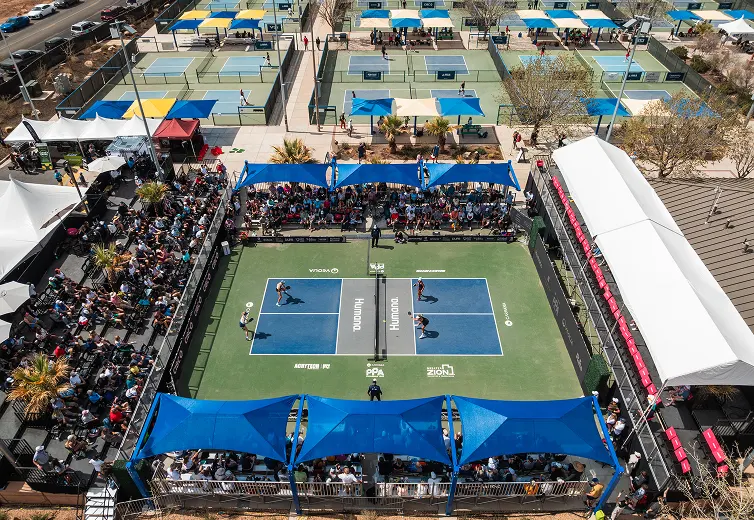
How a court gets built.
Everything that goes into a pickleball court that lasts, from the crew that builds the courts the PPA Tour plays on. Outdoor, indoor and tennis conversions.
Six decisions that decide whether a court lasts.
Base
Asphalt or post-tension concrete. Asphalt is cheaper and flexible; concrete moves less over time. Soil, climate and budget decide it, and we will tell you which we would pour on your site.
Drainage and slope
A court that holds water cracks early. We grade to a consistent 1% fall and design the surrounding drainage so water leaves the pad, every time.
Surfacing
Acrylic sport surfacing over the base: consistent bounce, traction, UV resistance and any color scheme you want. We are certified in Acrytech, Plexipave, DecoTurf and Rebound Ace, the systems we use on tournament courts.
Fencing and wind
Perimeter chain-link, divider fencing between courts, windscreens and gates, oriented for the site's prevailing wind.
Lighting
LED sports lighting sized for the number of courts and the hours you want to play, with glare control for the neighbors.
Nets and lines
Permanent or semi-permanent nets, regulation striping, and blended lines when a court has to share.
Turning a building into a club.
Multi-sport conversions
Tennis courts, basketball courts, gym floors and multipurpose rooms become dedicated pickleball courts. We add lines or rebuild the surface depending on the space.
Surface choice
Cushioned acrylic over concrete for a true competition feel, or modular systems where the building calls for it.
Sound
Pickleball is loud indoors. Wall treatments, surface choice and layout all affect it, and we design for it up front.
Facility fit
Ceiling height, HVAC, lighting, ADA access, spectator flow. We build indoor courts for The Picklr and Dill Dinkers, so we have the checklist.
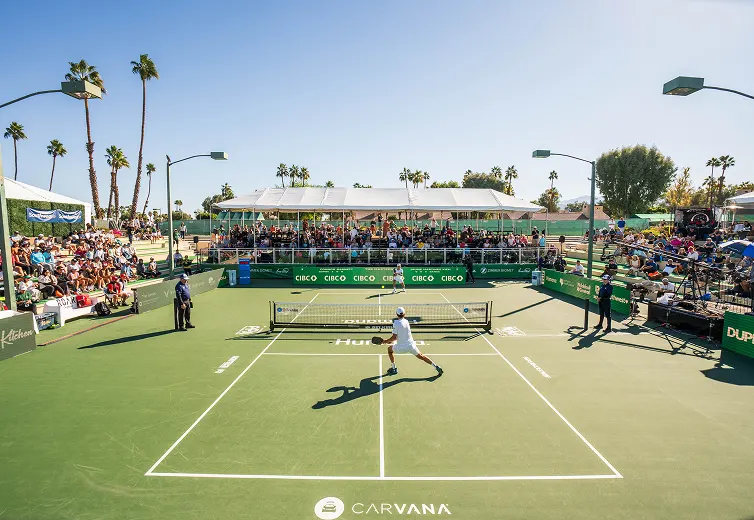
The numbers.
| Layout | Playing lines | Recommended pad | Use |
|---|---|---|---|
| Regulation court | 20 × 44 ft | 30 × 60 ft | Clubs, schools, parks |
| Championship court | 20 × 44 ft | 34 × 64 ft | Tournament play, broadcast |
| Tennis court conversion | 20 × 44 ft each | Existing 60 × 120 ft pad | 2 courts with run-off, or 4 with shared fencing |
| Net height | 36 in at sidelines, 34 in at center |
Questions we get every week.
- How big is a pickleball court?
- A regulation court is 20 feet wide by 44 feet long for singles and doubles. For tournament play we recommend a 30 by 60 foot pad so there is run-off room around the lines; 34 by 64 feet is better for championship courts.
- How many pickleball courts fit on a tennis court?
- Four, with shared fencing. Two if you want full run-off and divider fencing between courts. We will lay out the options on your actual pad before you decide.
- What is a pickleball court made of?
- An asphalt or post-tension concrete base, then an acrylic surfacing system. We are certified in Acrytech, Plexipave, DecoTurf and Rebound Ace, with cushioned systems (Plexicushion, Cushion X, Roll X) for indoor and club use.
- How long does a resurface take?
- Weather permitting, a standard resurface takes a few days per court group. We surface 17 PPA Tour events a year, usually in 5 to 7 days per event, so we plan for the deadline first.
- Where do you work?
- We have built or resurfaced courts in 46 states, and across Australia through Just Courts Australia.
Something else? Ask us directly.
Have a court to build, convert or bring back?
Tell us about the site and the timeline. We will come back with a plan and a number.